Why So Many Old Albums Are Back on the Billboard 200
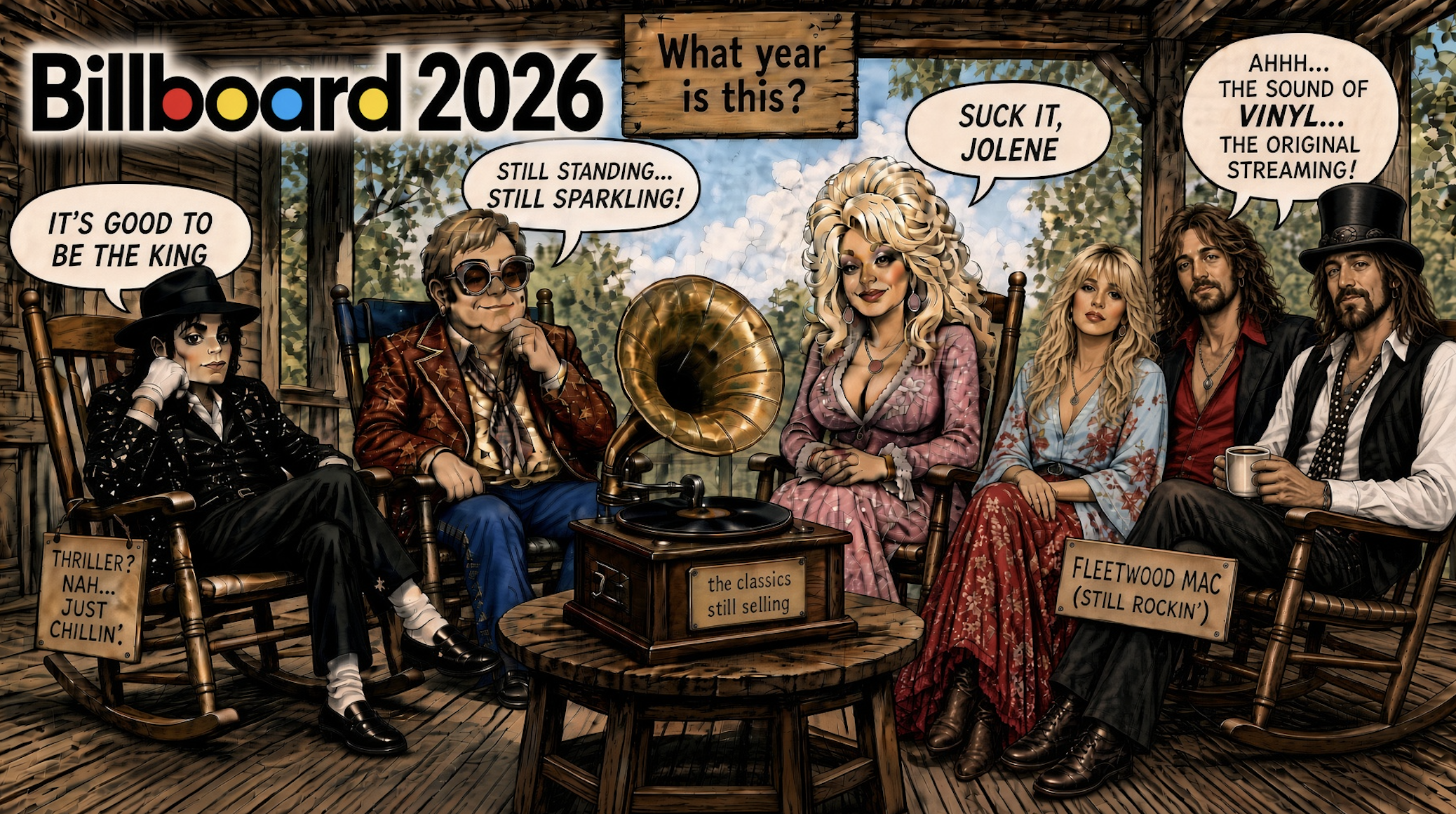
Take one look at this week’s Billboard 200 and it can feel like somebody left the chart machine running for 40 years. Michael Jackson has two albums in the Top 25, Fleetwood Mac has two in the Top 60, Elton John and Queen are both in the Top 50, and records by Nirvana, Journey, ABBA, Tom Petty and others are scattered all over the list.
The biggest reason is simple: the Billboard 200 is no longer just a sales chart. It measures album consumption, which includes traditional purchases, track-equivalent albums and streaming-equivalent albums. That means millions of plays of an old song can keep feeding the album or greatest-hits collection it belongs to. In 2026 Billboard also made streaming equivalents a little easier to generate, so catalog music that people play every day has even more power than it used to.
Thriller, Michael Jackson, #18
This is the least mysterious old album on the list. Jackson’s catalog exploded again after the Michael biopic, with Sony saying his streams rose to roughly four times their pre-release level and Jackson posting his best streaming week ever. Thriller is the natural landing spot because “Billie Jean,” “Beat It” and “Human Nature” are still enormous streaming songs, and the album has now spent 734 weeks on the Billboard 200.
Number Ones, Michael Jackson, #21
The same Jackson surge is helping this 2003 compilation, but greatest-hits albums have an extra streaming advantage: every time somebody plays one of the major songs collected on them, that activity can contribute to the album’s chart total. Number Ones has now logged 253 weeks on the Billboard 200 and, like Thriller, is also showing up on sales, vinyl and streaming charts.
Rumours, Fleetwood Mac, #31
This one never really went away. “Dreams,” “Go Your Own Way,” “The Chain” and the rest of the record continue to stream at a level that would have been impossible for catalog music in the old sales-only era. The album just crossed 700 weeks on the Billboard 200, and it also continues to sell on vinyl, giving it two different ways to keep piling up consumption.
Greatest Hits, Fleetwood Mac, #60
Fleetwood Mac gets a second bite because the hits compilation collects the songs casual listeners reach for without needing to play Rumours front to back. It recently crossed 400 weeks on the Billboard 200, and streaming has turned it into exactly the kind of all-purpose catalog package that can sit on the chart almost indefinitely.
Diamonds, Elton John, #39
This 2017 collection is a streaming-age monster because it concentrates decades of Elton John songs into one title. Every fresh listener who finds “Rocket Man,” “Tiny Dancer,” “Your Song,” “Bennie and the Jets” or “I’m Still Standing” helps the same compilation, which is why a package released long after most of the music was recorded can behave like a current album.
Greatest Hits, Queen, #41
Queen’s collection has spent more than 700 weeks on the Billboard 200 because the band’s biggest songs never stopped being consumed. “Bohemian Rhapsody,” “Another One Bites the Dust,” “Don’t Stop Me Now” and “We Will Rock You” are playlist staples, sports-arena staples and perennial discovery songs for younger listeners. Streaming turned that permanent cultural presence into measurable album units every week.
Chronicle: The 20 Greatest Hits, Creedence Clearwater Revival, #48
Chronicle was one of the best greatests hits of all and a testament to John Fogerty’s genius. “Fortunate Son,” “Bad Moon Rising,” “Proud Mary” and “Have You Ever Seen the Rain” beautifully hold up as powerfully today as when he wrote, sang and perform them. The album has now spent more than 800 weeks on the Billboard 200 because of one man: John Freakin Fogerty, who deserves more praise.
Curtain Call: The Hits, Eminem, #65
Eminem’s first greatest-hits set has become a catalog sponge for “Lose Yourself,” “Stan,” “The Real Slim Shady,” “Without Me” and other songs that continue to stream at blockbuster levels. Instead of those plays being scattered across a shelf of old albums, a large share of casual-listener activity lands on one compilation, helping it reach 804 weeks on the chart.
Nevermind, Nirvana, #66
Nirvana does not need a greatest-hits album to pull this off because so much of the band’s catalog gravity is concentrated on one record. “Smells Like Teen Spirit,” “Come as You Are,” “Lithium” and “In Bloom” keep bringing new listeners back to Nevermind, while vinyl sales give it a second source of chart units. It is now at 790 weeks on the Billboard 200.
Greatest Hits, Tom Petty and the Heartbreakers, #68
Petty’s compilation is another one-stop catalog title that benefits every time “Free Fallin’,” “I Won’t Back Down,” “Learning to Fly” or “Mary Jane’s Last Dance” gets streamed. The old record-store logic said a greatest-hits set sold once; the streaming logic lets it earn another tiny fraction of an album every time somebody presses play.
Journey’s Greatest Hits, Journey, #83
There may be no better example of one song keeping an entire catalog package alive than “Don’t Stop Believin’.” Add “Separate Ways,” “Any Way You Want It,” “Faithfully” and “Open Arms,” and Journey has a compilation that functions like an always-on classic-rock playlist. It has now spent 925 weeks on the Billboard 200.
Gold: Greatest Hits, ABBA, #93
ABBA’s biggest songs have spent decades being recycled through radio, movies, stage shows, weddings, parties and now algorithmic playlists. Gold is the obvious destination for all of that listening. “Dancing Queen” alone is a global evergreen, but “Mamma Mia,” “Take a Chance on Me” and “Gimme! Gimme! Gimme!” keep the whole package moving.
Greatest Hits, Guns N’ Roses, #106
GNR’s hits set has been hanging around the chart for years because the band’s giant songs remain giant songs. “Sweet Child o’ Mine,” “Welcome to the Jungle,” “Paradise City” and “November Rain” continue to rack up streams, while every tour cycle introduces the catalog to another wave of ticket buyers who go home and hit play.
Greatest Hits, 2Pac, #108
Hip-hop catalog behaves just like classic rock catalog now. “Changes,” “California Love,” “Dear Mama” and “Keep Ya Head Up” remain gateway songs for listeners born long after 2Pac died, and the greatest-hits collection captures that discovery in one place. That is why a 1998 compilation can still sit in the middle of a 2026 album chart.
Legend: The Best of Bob Marley and the Wailers, Bob Marley and the Wailers, #138
Legend is one of the clearest examples of catalog music behaving like a current release. “Three Little Birds,” “One Love,” “Could You Be Loved” and “Is This Love” are continuously streamed around the world, and the 2024 Marley biopic gave the catalog another major discovery cycle. The compilation is now at 955 weeks on the Billboard 200.
Toxicity, System of a Down, #154
This is a younger catalog record than the classic-rock titles above it, but it is now a quarter-century old and still behaves like a live release. “Chop Suey!” has more than a billion YouTube views, while “Toxicity” and “Aerials” remain hard-rock streaming standards. Heavy music has become especially good at keeping old albums together instead of reducing them to one or two isolated songs.
Metallica, Metallica, #172
The Black Album is another case where the entire record remains part of the culture. “Enter Sandman,” “Nothing Else Matters,” “The Unforgiven” and “Sad but True” are still streamed in huge numbers, and Metallica’s ongoing stadium-scale touring keeps sending people back to the catalog. The album has spent 848 weeks on the Billboard 200.
Greatest Hits, Earth, Wind & Fire, #197
This one actually did re-enter the Billboard 200 this week, and “September” is the obvious engine. The song gets a recurring seasonal bump every September, but the compilation also collects “Shining Star,” “Let’s Groove,” “After the Love Has Gone” and other songs that remain wedding, party and playlist fixtures. In the streaming era, a seasonal song can pull an entire old album back onto the chart with it.
The funny thing is that most of these records are not really “back.” They are living in a chart system that finally measures the way people actually listen now. A teenager playing “Dreams” from a recommendation, a dad putting on “September” at a cookout and somebody watching “Billie Jean” on YouTube can all wind up contributing to album consumption. The result is a Billboard 200 where 1976 and 2026 can sit next to each on the chart the same way they live in our hearts.